

Trump and the right’s odd relationship with a good workforce idea.
A pretty good bipartisan bill has potential to expand a great hiring strategy that the Trump Administration has aimed at fighting DEIA, for some reason.

The issue.
Many Republicans have backed skills-first hiring, a good idea for increasing access to good jobs by folks who definitely have the talent to do them well. Republicans also are shepherding a good, bipartisan bill on the topic through Congress.
The bill has potential issues that need careful implementation by a Trump White House that wants to maneuver skills-first hiring as a tool to fight things that, uh, it really isn’t good for fighting…
Explain.
Here’s the good news: last week, the House of Representatives passed a pretty good bill using the federal government’s contracting powers to expand skills-first hiring.
For the uninitiated: skills-first hiring means hiring processes built around discovering the skills an applicant actually has instead of relying on things—like college degrees—that might show they have the skills.
Last week’s bill, sponsored by Rep. Nancy Mace, R-S.C., and Rep. Raja Krishnamoorthi, D-Ill., bans agency officials from mandating in a proposal that a contractor’s staff meet “minimum education requirement[s],” which the bill defines to basically mean coursework and degrees earned at a college. The bill, which notably has the backing of IBM, allows agencies to still require staff education requirements by explaining how the agency’s needs from the project can’t be met without those requirements.1
“We call it the paper ceiling and today we tore through it,” Mace said in a statement after its passage. “This is a win for every American who has put in the work, built real skills, and deserves a fair shot.”
As Mace’s statement indicates, skills-first hiring is most commonly associated with companies and governments shedding requirements that their staff have bachelor’s degrees, even if there is no job-related reason workers need to have one. Advocates for skills-first hiring—myself included—will tell you that shedding degree requirements is only part of the work. The holdup has been that employers need to do real work to identify the skills they need, figure out how to hire for them, and make sure people actually get hired. So far, though, research suggests employers are doing a good job of killing degree requirements, but not hiring people without degrees. That’s most likely because getting rid of the degree, alone, doesn’t mean employers are actually going through their hiring process to sort how to catch and hire talent that they’re otherwise missing.
Getting rid of the degree requirements in federal contracting could help, though. Companies have lamented that the federal government’s continued mandate of degrees for the staff has frustrated their efforts to adopt skills-first hiring.
The implementation challenge.
Here’s the not-as-good news: if enacted, this is a bill where intentions will really matter to make sure that it actually helps the problem instead of perpetuating it or making it worse.
Government contracting, like so much of government, frequently gets snared by the perpetual motion of keeping the government running. It’s not hard to see a world where contracting officials find an easy way to keep mandating the same education requirements they always have even with the required justifications.
It’s that kind of inertia that slows or prevents change in any institution. Accordingly, regulations implementing Mace’s bill will need to make sure that the justification isn’t just a perfunctory requirement, but something that drives contracting officials to really consider what skills contractor staff really need and how they can get them outside a degree.
There’s also a risk that this bill, as drafted, could create new barriers to skills-first hiring because it’s so broad that federal contracting officials must justify preference for virtually anything you learn at a college. Another reason that skills-first advocates will tell you that you shouldn’t just think of the policy as “banning degrees” is that degree requirements can lead to the undervaluing of degrees that are relevant to skilled jobs. Put one way: there are four-year degrees highly relevant to doing a job that don’t have the name of the job in the major.
Put another: one degree that’s also undervalued are associate’s degrees like those issued by more affordable and accessible community colleges. Mace’s bill requires contracting officials’ write a justification for associate’s degrees and even short-term credentials if they were issued from a community college.
To be clear, there’s nothing in the bill saying those officials can’t preference credentials and degrees earned at community colleges. But just as they could try to find a way to do the same-old same old with four-year requirements, the constant movement and pressure of the bureaucracy mean those officials likely won’t consider the in-between of no education requirements and four-year degrees unless they’re directed to by regulation.
No bill or policy move is a perfect silver bullet, but I think these details mean this bill could have a significantly greater impact if regulators bring a nuanced and thoughtful approach to what skills-first hiring is and how to make it work.
‘Merit’ and skills-first hiring.
Which brings us to not-so-good news: there are reasons to be concerned that the Trump White House—which the bill tasks with issuing guidelines for implementing it—doesn’t really get skills-first hiring.
I have done a lot of work around skills-first hiring, including engaging more conservative groups on the issue. More than 30 states’ leaders back efforts to spread skills-first practices, particularly in state government, with many Republicans framing it as what it is: a good idea and needed fix for a labor market far too focused on excluding talented workers in the name of expediency, gatekeeping, or just misunderstanding of who is qualified for a job.
Coalition-building, of course, doesn’t mean everybody has to agree on everything all the time. Yet, after researching the issue last week, there is enough here to flag that some on the right really want to portray skills-first hiring as a “solution” for something that, uh, the numbers say they really shouldn’t: diversity, equity, inclusion, and accessibility initiatives meant to make it easier for people of color and others to get hired into workplaces they were shut out of for reasons other than talent.
The Trump Administration is among them, explicitly tying its skills-first hiring push as part of anti-DEIA efforts. The President recently connected these efforts to his belief that the civil rights movement that led to integration meant that white people who “deserve[d] to get a job were unable to get a job.” The President also has indicated diversity efforts create incompetent workforces. In turn, “merit” has become the Republican word of choice in rolling back DEIA and workplace protections of the kind opposed by the President.
In May 2025, the Office of Personnel Management, the federal government’s main HR office, directly connected “merit” with skills-first hiring in setting new hiring guidelines meant to meet the President’s called-for changes to the civil service. In a memo that called DEIA “[i]llegal, demeaning, and immoral,” OPM described a core idea of its changes as:
Implementing skills-based hiring, eliminating unnecessary degree requirements, and requiring the use of rigorous, job-related assessments to ensure candidates are selected based on their merit and competence, not their skin color or academic pedigree[.]
Notably, the memo punts on how to do skills-based hiring to meet the goals above, only talking about things OPM plans to do.2 It does describe a set of required essays about supporting the President’s agenda. The essays—which Axios reported will apply janitors, nurses, and surgeons—ask candidates, among other things, to identify executive orders that the job will help implement, which doesn’t exactly speak to the technical qualifications of the role.3
There was also, uh, this from last August:
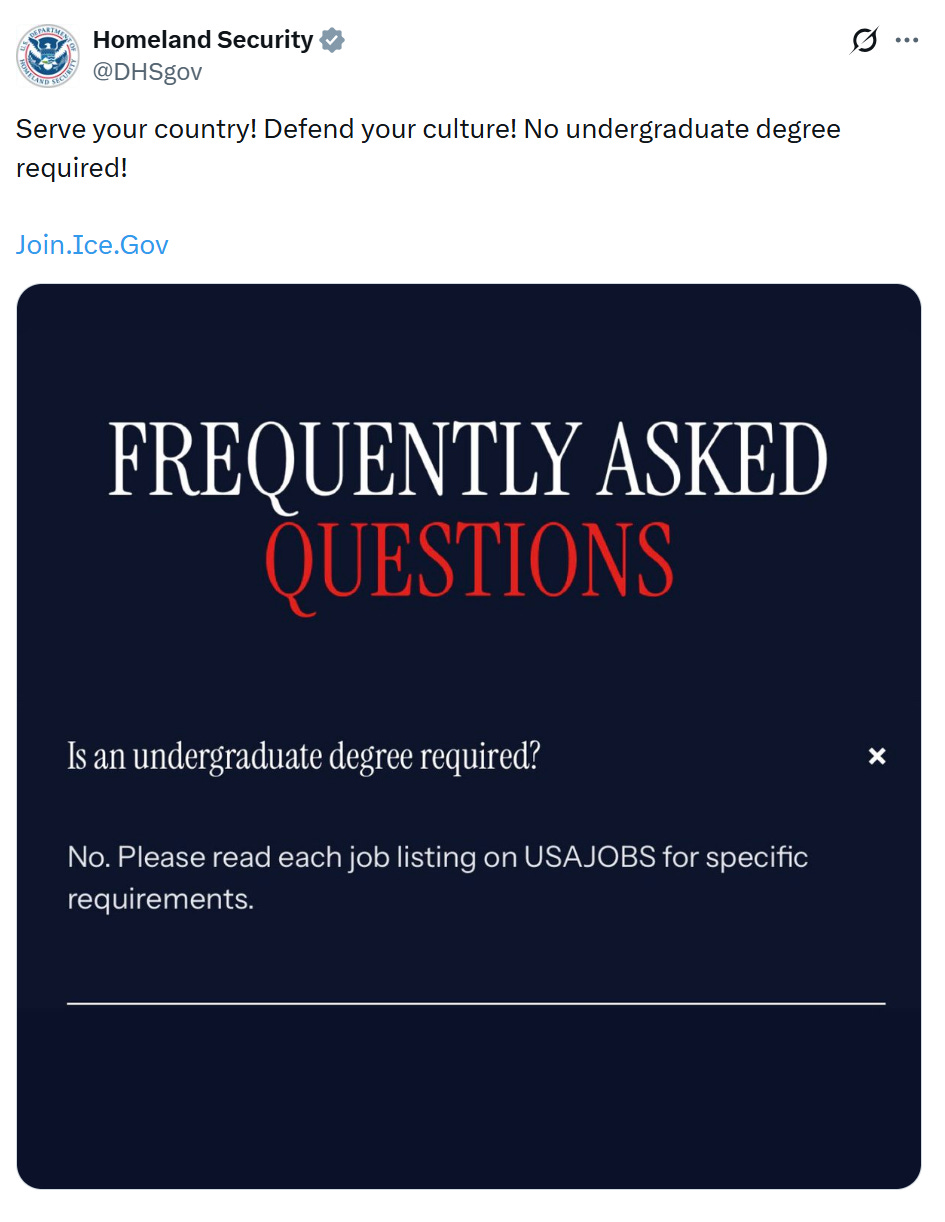
Mace is very aligned with the Administration and appears to have tried to connect her bill with the President’s anti-DEIA work, at least in passing. The very last paragraph of her statement paints her bill’s movement through Congress as a victory for “merit.” She has done the same in other press releases that, even while talking up the bill’s bipartisan support, explicitly tied it to the Trump executive order tied to the anti-DEIA hiring guidelines I describe above.
Mace has used “merit” so much and so emphatically in the context of counteracting DEIA that I think it would take a lot of ridiculous political hairsplitting to try to break the connection. Last August, Mace introduced the “Restoring Merit in the Military Act,” which her office called a “push to end woke DEI policies and restore strength, merit, and fairness to the military.” A month later, her office portrayed a bill attacking the D.C. city government’s DEIA efforts as part of her broader work to restore “merit.”
If using skills-first hiring as a tool for fighting DEIA seems counterintuitive to skills-first hiring, well, it kind of is. While I haven’t talked with every conservative skills-first advocate to see if they like DEIA, I suspect some of the ones I know would say that question is beside the point, especially if they are economically and statistically minded. They see jobs that need filling. They know there are people who are not getting those jobs for reasons that are inefficient and don’t make sense.
They also have likely looked at the evidence showing who is more likely to benefit from unnecessary degree requirements. White students make up the biggest plurality of four-year university students and one analysis found a clear majority (52.3 percent) when excluding data on international students. Historically, educational attainment statistics have shown that a large majority of bachelor’s degree holders to be white.
It’s worth noting these numbers can be spun quite a few ways. I suspect one statistic has been quite appealing to the Trump political operation: around 56 percent of white men older than 25 don’t have degrees. Yet, a larger percentage (64 percent) of all Black workers—in the same age range—also don’t have degrees, suggesting they could stand to benefit from a shift to skills-first hiring.
So what should we do about it?
Well, let’s be clear, I’m not looking for perfect ideological purity from supporters on skills-first hiring. It’s just a damn good idea that fixes a lot of problems in the labor market. That’s part of its appeal across the left and the right. There are nuances here that would be great to address in implementing Mace’s bill, but it’s still good.
My concern is that a compulsion for perfect ideological purity could be a barrier to skills-first hiring’s wider deployment. Skills-first hiring isn’t, nor should it be, a method of attacking DEIA. Math suggests it’s a real bad one. Because there is nuance, intentions matter here, as does understanding what skills-first hiring actually does and why you do it.
On that note, something my research turned up was a feeling among some supporters that Trump II has talked more about skills first than it has done actual deployment. That’s not unjustified. The Heritage Foundation’s blueprint for Trump II, Project 2025, actually called for policy nearly identical to Mace’s bill, but recommended that the President enact it via executive order.4
A new statute on federal contracting definitely makes things crystal clear, but it’s unusual for Trump II—which you might have noticed has tried to do a lot by executive order—has not moved more on a strategy it’s talked up in several other places.
Which raises the question: Why?
Card subject to change.
First, mind your emails. I have a big announcement coming about this newsletter.
Whether Thursday or another day this week, I’ll have a piece unpacking a few odds and ends in the latest on the Labor Secretary scandal. What’s worse than having a POLITICO piece ask precisely how banned the Labor Secretary’s husband is from the DOL headquarters? Probably a New York Times piece raising the question of did the Secretary know her party was a birthday party and when did she know it. Because she might have told Congress she didn’t have a birthday party, but did. Great.
For Thursday’s edition of THE MONEY, I would expect a lot of apprenticeship stuff, including some of what I’m hearing about the Trump incentive funds, the ways Trump II made its apprenticeship goals harder than they needed to be, and strangely enough, something I found while researching Mace’s bill.
Next Tuesday, I have something fun and different for this space: the fascinating backstory for a neat workforce tool created by an unexpected source—and what I think policymakers can learn from it.

So, for any self-taught nuclear physicists who’ve turned their dishwashers into particle accelerators, apologies for getting your hopes up.
In late December 2025, OPM issued a set of position description templates, but noted that they were only “foundational” and provided very few specifics on how to actually evaluate candidate skills in alignment with these templates. That limits their utility in actually being deployable to hire candidates based on skills in the ossified environment of federal hiring.
I would caution that no administration is ever 100 percent aligned on the issues, no matter what they say. To that end, the Trump workforce blueprint published last August put forward a pretty thoughtful take on implementing skills-first hiring without any reference to DEIA whatsoever, saying the agencies involved
will support the adoption of skills-based practices across education, workforce, and corporate human resources systems that prioritize demonstrated ability over formal credentials. Skills-based approaches can improve hiring, training, and advancement decisions when grounded in clear, job-relevant evaluations. To support this shift, the Departments will promote models that move beyond simply making inferences about an individual's skills and instead evaluate the direct demonstration of those skills.
My understanding is that the blueprint was largely the work of agency officials who I feel pretty strongly have a better sense of what skills-first hiring actually is and how it works than what might show up in more intensely White House-directed work, which I think is a fair description of the OPM efforts. The White House budget office would take the lead on drafting regulations under Mace’s bill.
There’s a whole other intrigue to this Project 2025 chapter worth noting here because it raises questions about skills-first hiring and what are actually useful ways of furthering it. The chapter, which is written by now-Solicitor of Labor (and Department of Labor No. 3) Jonathan Berry, appears to be the only one to include “Alternative Views” notes that evidently reflect places where Heritage disagreed with the author.
Berry, who I worked with when I was career staff in Trump I, calls for Congress to adopt what is effectively a ban on all private employers requiring bachelor’s degrees in hiring. The alternative view disputes that by saying
it is not the federal government’s role to determine whether private employers may or may not include degree requirements in job descriptions and in their hiring decisions. The inappropriate reverence given to degree requirements is a byproduct of the federal government’s heavy subsidization of BA degrees. Phasing down federal subsidies would be a better way to eliminate barriers to jobs for individuals without BA degrees.
Putting aside Heritage’s own effort to twist skills-first hiring toward other conservative saws, all but a few organizations advocating for skills-first hiring prefer enacting it through voluntary employer adoption. Speaking from a legal and policy implementation view, that’s pretty much the best way to go about it because effective adoption of skills-first hiring is a very individualized process of assessing what skills (or skills evidenced by degrees!) actually are needed for a job and how to gauge them.