

Still workin': How student loan changes could make worker shortages worse.
And how universities might use Workforce Pell as a way to survive.

Note
Hey, y’all, I’m working on something exciting that I can’t wait to announce. In the meantime, I wanted to update and revisit this increasingly relevant piece on the future of college after last summer’s student loan changes.
Come hear me talk workforce stuff.
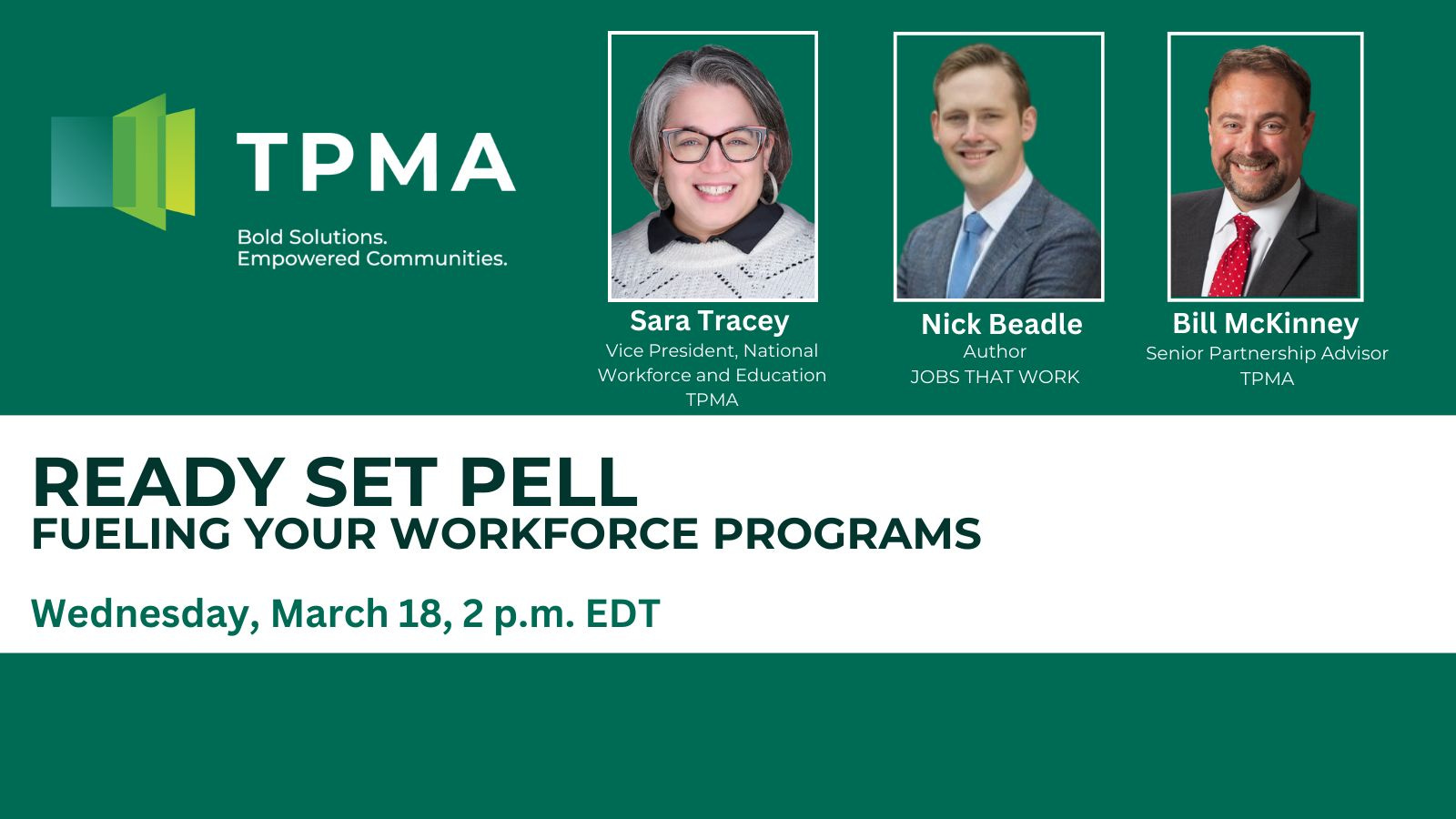
Sign up here.
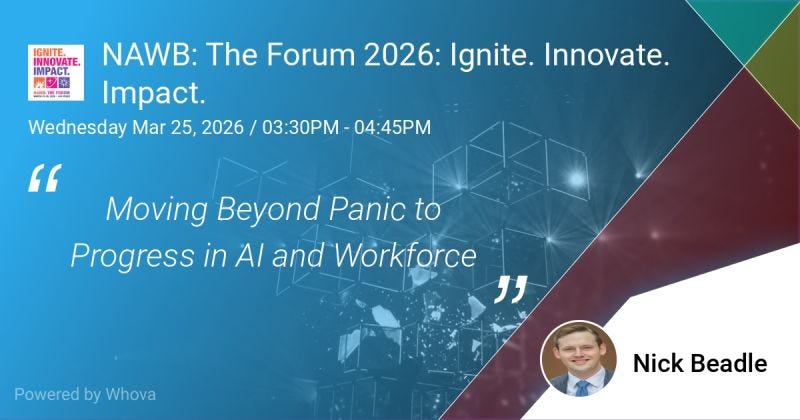
Late registration details here.
A version of this piece published on July 8, 2025. It’s been updated and modified based on new developments since its original publication.
The issue
Last year, Congress did its best to slam the door for people without means to reach higher-wage occupations requiring a degree. We kind of need those people to fill some awfully important jobs.
Maybe they still can.
Explain.
I’m a first-generation(ish) college student.1 Over the years, folks in higher education have picked my brain on how they get more students from low-income or first-generation backgrounds at four-year schools. At times, I have said “Give them money” far more quickly than wanted or appreciated.
To put it in very simple math: college costs money. People who don’t have money don’t exactly have the best sense of how to get money because they don’t have any. Giving those people the means by which they can cover the cost of college (money) results in more of those people going to college.
It also makes them feel secure enough to aspire to fill jobs that employers and society needs filling. I do think we need fewer jobs with degree requirements and more effort to actually hire people without degrees. It’s also true that we still have jobs with shortages where it’s going to be hard to ditch the degree. Some of them are awfully important and hard for AI to replicate, like nursing and medicine. Heck, increasing the number of people in medicine whom, upon occasion, might not have had means has been shown to improve the quality of care.2
Of course, giving money to people without money at scale is… not exactly how higher education works. I have been part of this conversation for two decades now. Speaking very frankly as someone who entered college as an outsider, that mindset doesn’t sync with universities’ longtime role as a gatekeepers for wealthier layers of American society. There are institutions that do a better job at opening doors, but for many college administrators and donors, poor students don’t look as likely to be someone who will come back and help the school later as those who already have means.3
I think that shows an extraordinary lack of imagination, but I also acknowledge that the ragged politics and economics of higher education also have incentivized some schools to cater even more toward wealthier students. Midway through my time at Alabama, my alma mater made changes to scholarship funding that, had they happened a couple years sooner, would have prevented me from having the money I needed to go to school there. The reason why? To attract higher-spending, out-of-state students from wealthy suburbs to help make up for below-average state funding.
Even that option likely will go away very soon for many schools. Declining birth rates mean that there aren’t as many wealthier kids to go around. Given that we already have too many four-year schools and decreasing demand, a good many of them could go away in the coming years because of a lack of students to help pay the bills.
These are all complicated problems that have gotten harder over the past few years as the cost of college ballooned and the return on that investment has appeared to diminish for many young people.
Don’t worry, though: Congress is always here to make things worse.
The big cuts.
Last summer, Congress passed the “One Big Beautiful Bill Act,” the second Trump Administration’s signature legislative accomplishment and a law that Republicans are notably trying to rebrand as the “Working Families Tax Cuts Act” after reportedly flirting with renaming entire agencies after its big and beautiful moniker. In addition to doing many other things that will make it harder for people to climb socioeconomic rungs, Congress effectively cut off access to jobs requiring a four-year degree for many students from lower-income backgrounds.
Congress installed new borrowing caps that are unlikely to keep up with attendance costs—even at in-state tuition levels—for many students.4 The bill sets $50,000-per-year borrowing caps on professional degrees and a $200,000 lifetime cap. Both will make it harder for a student without means to enter medical school, which has an average cost of $60,000 per year and $240,000 overall.5
Of course, these changes accomplish a key goal of the current congressional majorities. Aside from “apprenticeship stuff” and “efficiency,” “We need fewer people going to college” has pretty much been the mantra of this Congress on workforce. The bill certainly will assure that.6
So where will students go if they can’t afford college? Last year, there were arguments that if you prevent young people from going to college they will head to the trades or the factory floor,7 where employers says they are struggling to find workers, albeit for questionable reasons. I think that’s unlikely. For one, it requires more money than I think the Administration and Congress are willing to spend.
That is not to say what Congress left behind is all bad for college or the workforce. I think there is a potential lifeline here for universities if they are willing to crack the gates a little bit wider for people without an abundance of means.
The ‘small-plates degree’ and where it stands.
One Big Beautiful did give us Workforce Pell, which is, uh, in its own special place now, with states and the folks who deal with them quietly, but increasingly, gloomy about its targeted start in fewer than four months. Long term, though, I think Workforce Pell could provide a lifeline to the public universities willing to take it.
Congress required that Workforce Pell dollars support programs that provide credit toward certificates or future degrees. Put another way, when you complete a program eligible for Workforce Pell, it could count as a chunk of what you need to earn a full degree later.
Public four-year schools should take advantage of the changes in the law by splitting up the degree for degree-required jobs where they already have a competitive advantage or outright own the market, such as medicine or engineering. This would engage the return-on-investment concerns colleges face with many young people by making it slightly less of an investment and help fill jobs where we need students who aren’t turned off by the price tag.
In other words, universities should set up programs where students can earn a few chunks of the degree and use them to get a job that matches their proven skill level, then finish the rest if they think they want it later.
By making this approach more affordable and marketing it as such, universities could make up for potential revenue gaps by opening the door to more students who can pay a lower price point for some college, but not all of it—even with loan cuts. This would disarm the impact of the reduction in wealthier students due to the enrollment cliff. Also, unlike community colleges and workforce providers, four-year schools have more resources to navigate the bureaucratic switchbacks in Workforce Pell and help both themselves and their students maximize available funding—if they’re willing to do it.8 Their small-plates degree programs would have more credibility due to their universities’ existing brand and cache and relationships with large employers.
It won’t be easy: as I read the requirements, colleges will have to fund these programs on spec for at least a year to access a relatively small amount of Workforce Pell cash. The so-called “commuter schools” built on helping midcareer professionals get ahead probably will seize upon this opportunity, but I don’t think it’s unfair to say there are some administrators and alumni who would rather their universities gatekeep than survive.
So far, I’ve not seen signs that lead me to believe that universities are open to going down this route. For example, I was excited to see two land-grant universities with decent reputations in the workforce space—Mississippi State and Michigan State—show up in the list of recipients of a rushed Department of Education competition last fall to help seed “reform” of college programs to meet Workforce Pell requirements. Their project summaries indicate a narrow focus on creating new certificate programs, as do summaries for other universities in that pack of awardees.
I don’t want to dismiss those projects, nor do I want to automatically lump its potential results with the poor track record certificate programs have in actually improving employment prospects. But whether it’s universities being cautious amid bureaucratic uncertainty, or the Trump Administration’s shortsightedness, these projects felt remarkably unambitious compared to what seems possible. The potential is still there in Workforce Pell to reimagine—and open up access to—higher-education degree programs we still very much need no matter how much the Administration’s social media accounts claim universities are “woke.”
And as much as the four-year college experience is not made for people without means, opening the door to more of them is as viable a strategy as any to help colleges survive this moment as anything else.
Card subject to change.
Thanks for joining me on this kinda-sorta-mostly walk down memory lane. Next week, I’ll have an interview with someone who’s working on this pack of issues, which only get more complicated.
If you’re in the apprenticeship business and somehow missed it last Friday, I strongly recommend you read my piece on DOL’s new apprenticeship guidance, which could fundamentally change how American apprenticeship gets run. On Thursday in THE MONEY, I’ll have some clean up on remaining bits and pieces in that guidance, along with some thoughts on the Hill, which is still tossing workforce bills out there.

I fit within most definitions I have seen of the “first generation” label and I use “first generation” from time to time when folks need stuff in tidy buckets. I took my first college classes when I was 13, at least a year ahead of when my mother started hers, even though she finished a degree a couple years before me. Life is messy, though, and we’re living in an especially pedantic time of American politics, so I flag here that I use a load-bearing “ish” as necessary.
I would appreciate this as someone who has gotten plenty of blank stares from medical professionals when I explain my family didn’t have health insurance when I was younger and that’s why one thing or another didn’t get fixed.
To show my work: the University of Florida has one of the country’s lowest in-state tuition costs at around $6,400, but it estimates its average in-state cost of attendance at $24,180, or $96,720. The lifetime cap on borrowing (without repayment) is $57,000 for independent students and $31,000 for dependent students. If you’re a dependent, the new law caps your parents’ borrowing at $65,000. Thus, at Florida, which is on the lower end of in-state costs, the new federal limits leave students $720 short under the school’s own estimate, and that’s before you get into the added complication of annual borrowing limits.
There are on-paper ways of making up that gap, obviously, but (1) estimated cost-of-attendance figures tend to be lower than they actually are and (2) yikes.
“But what about private loans?” you might ask. I can tell you from personal experience that if the choice is don’t go to school or go to a bank—where they feel considerably out of their depth—many young people (and their parents) from low-income backgrounds will choose the former, not the latter. Strangely, if you don’t have money, bankers don’t seem quite as friendly as they might for others.
I do think there is genuine belief among some lawmakers that imposing these loan limits will solve the student loan crisis by avoiding students from low-income backgrounds getting a college degree that doesn’t pay off professionally. Based on these lawmakers’ approach to finding solutions, they are liable to light your kitchen on fire if you mention you didn’t have enough to eat for dinner last night. Which frankly syncs with other parts of the One Big Beautiful Bill Act.
Thing is: you don’t have to kneecap the ability of young people who do want to go to college to motivate younger people to want to go into the trades and manufacturing. There has been a massive surge in interest in these occupations in recent years. The minds already have been changed, and policymakers just needed to follow through on it through expanded federal funding for workforce training programs. Workforce Pell likely won’t be enough to help them out here, especially the golden population I wrote about in November.
Early signals? Not so much. Bluntly, I think the gatekeeping is a part of it, but I also think that universities have had so much thrown at them by this administration that they don’t have the resources or headspace to really grasp the opportunities here, let alone do the increasingly fraught-feeling bureaucratic engineering to tap into Workforce Pell funds. This may be more of an opportunity once we get through year one, but it’s disappointing that more universities aren’t aboard this boat yet.